Our double vinyl release is available on Bandcamp! Just click on the Bandcamp button to order your copy today. Vinyl sales that exceed production costs will be donated to music education and outreach programs for young Clevelanders. What better way to invest in our future?
A lot has happened since the Live Recording of Ensemble HD at the Happy Dog on December 4 and 5. If you have been following these posts, you have a sense of the combined efforts of musicians, engineers, producers, graphic designers, videographers, photographers, impresarios – artists all.
The kernel of the idea of bringing chamber music to a broader audience and the experience of hearing the music is best captured by Charles Michener, a Cleveland native and internationally recognized arts writer and arts advocate. His essay is included in the liner notes of the double album vinyl release.
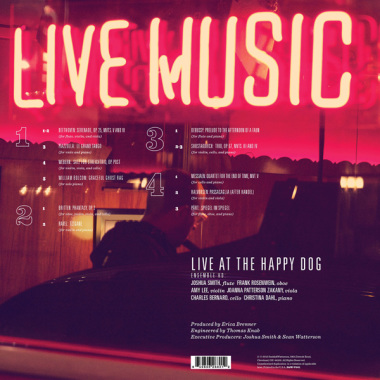
Ensemble HD is about to release its first recording, “Live at the Happy Dog,” recorded at the celebrated hipster Happy Dog bar in Cleveland’s Gordon Square Arts district. Putting all rules aside, Ensemble HD is taking straight-up chamber music and serving it with gourmet hot dogs and brew. Hear the audience erupt in cheers to Beethoven, or murmur admiration of Shostakovich as glasses clink and sirens and busses pass on the street outside. On a December night, in this local watering hole in Cleveland, it was about friends and fellowship and food, but as the final beers were served and the crowd settled in to hear the last set, it was all about the music.
Video Montage – Vinyl Production of “Live at the Happy Dog”
Special thanks to Gotta Groove Records for allowing us to film the process and to Vince Slusarz, Chris Smith, Ray Scott and Matt Earley for taking the time to show us around.
Joshua Smith, Founder of Ensemble HD, flew to Washington DC to speak at the National Endowment of the Arts (NEA) Council meeting. He was invited talk to the Council about the international attention received for Ensemble HD’s chamber music performances at the Happy Dog. Speaking with Mr. Smith was Joan Katz Napoli, Director of Education and Community Programs for the Cleveland Orchestra. In a time of dwindling audiences for traditional classical music performances, how have The Cleveland Orchestra and its musicians moved to the forefront of outreach innovations? The NEA wanted to know.
Photo by Joshua Smith
Link to the NEA Blog Page:
Archived Presentation:
World class record production requires a lot of collaboration. Artisans like Clint Holley of Well Made Music are an essential part of the process. We started with superb recorded sound from Erica Brenner, producer and Thomas Knab, recording engineer. But how to transfer the beautifully mastered sound to vinyl? Clint is one of the best in the business at bringing great sound to vinyl. Here Clint transfers the recorded sound to a lacquered disk. The machine that cuts the lacquer is a Neumann – VMS 70 cutting lathe – meticulously restored a few years ago by a recording technician who was in his 80s.
Clint lowers the sapphire cutting stylus onto an aluminum disk coated with nitrocellulose lacquer. The calculation of the groove spacing is a meticulous process. Any imperfections in the coating or cutting of the lacquer will diminish the quality of the final record. This lathe, built in the early 1970s, cuts the lacquer disk with a precisely engineered mechanism. The disk is held in place by a vacuum to keep it secure on the lathe. The magnetic coils that move the cutting stylus get hot as they move. To keep them cool, helium gas flows past them to remove the heat. Helium is used because of its high specific heat. The spirals of cut lacquer coming off the stylus are quickly drawn off the disk by vacuum.
This is the cutting stylus. The small tube entering the top of the yellow triangle of the cutting head, supplies the cooling helium. The metal tube to the right of the stylus, is the vacuum that removes the cut lacquer. Depending on the characteristics of the recording, a sapphire stylus can cut up to 2o hours of music. For the Ensemble HD recording, Clint used a new stylus to insure optimal sound quality.
To check the cutting, Clint can play the lacquer with a tonearm built into the lathe. Generally, only the test cuts are played back. The final lacquer is seldom played because that would diminish the sound quality. Once the lacquer is cut, it is inspected with a microscope to make sure the continuous spiral groove has been properly cut. If it passes inspection, the lacquer is inscribed with a serial number, removed from the lathe, and immediately sent off for plating. The series of nickel plates that are produced from the cut lacquer will be used as stampers to press the vinyl record.
For more information about the process of making a vinyl record, check out the Test Pressing post and video.
Many thanks to Clint Holley of Well Made Music for the tour of his studio. He clearly loves his work!
Erica Brenner, Producer, and Paul Blakemore, Mastering Engineer, inspect side A of the first test pressing of Ensemble HD, “Live at the Happy Dog”
Listening to the first test pressing from the console of Concord Music Group sound editing studio. Thank you to Paul Blakemore for the use of his amazing studio!
While Ensemble HD Members are performing with the Cleveland Orchestra in Miami, FL, or teaching and performing at Stony Book, NY, Sean Watterson, Co-Owner of Happy Dog grabbed the test pressing from Gotta Groove Records. Sean Watterson, Erica Brenner, producer, and Tom Knab, recording engineer will be checking it out tonight at Concord Music Group studio. Can’t wait!
From our cut, lacquered disks of the recorded music, Mastercraft Metal Finishing produced a nickel stamper disk, called a Master. This image is of our Master disks installed in the vinyl record press. Gotta Groove records produced a test press from these Masters. The recording team will listen to the sample to make sure the sound fidelity meets their high standards. We’ll let you know our first impressions, so to speak.
Here are some views of the process:
Metal master plates arrive from plating company.
Master plates are carefully installed onto the vinyl press at Gotta Groove Records in Cleveland.
Masters are installed and ready for the test press.
A glob of hot vinyl, called a biscuit, is sandwiched between two record labels, then mechanically dropped into the center of the record press.The press closes on the biscuit at 100 tons pressure at 380°F. The vinyl is squeezed to the thickness of a record with the ridges of the Masters pressed into its surface creating the grooves of sound. This image shows the placement of the biscuit between the two Master disks.
Next, the extruded excess vinyl is trimmed from the edges of the record
The test record, with labels fused to its surface, drops onto a spindle. Now to hear how it sounds!
Photos by Matt Earley of Gotta Groove Records
If you want to know more about record production, check out this 10 minute video:
Cleveland artist Oliver Barrett just submitted the album artwork to Gotta Groove Records for production. The collaboration between Oliver, national arts writer/editor, Charles Michener, local photographers and our production team resulted in an album concept that captured the vibe of the live event. The visual and aural appeal are in perfect harmony.